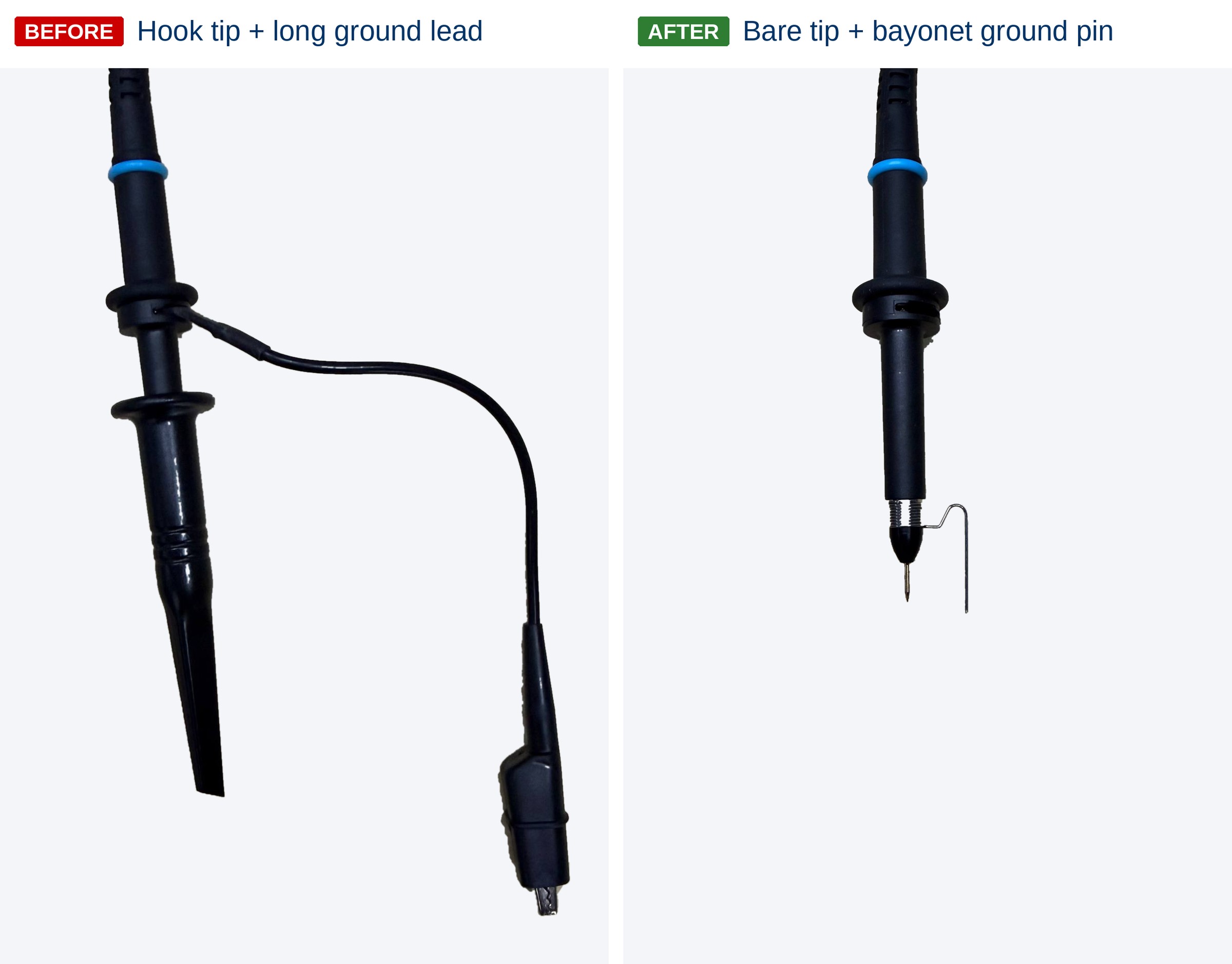
Beware of probe loading artifacts with passive probes
Passive probes come standard with most oscilloscopes, and jumper wires are often used to reach test points. This article explores the hidden effects of probe loading, and why the overshoot and ringing you see on your oscilloscope may not reflect the true signal in your circuit.
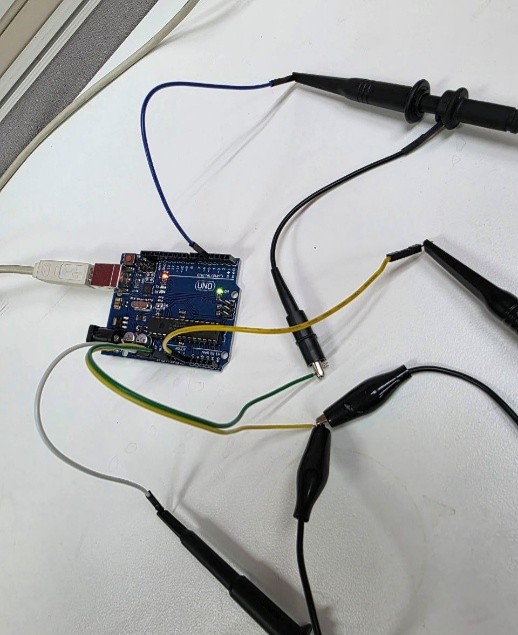
Fig 1: Typical setup, with jumper wires connecting a passive probe to active electronics.
On an oscilloscope, a waveform like Fig 2 often appears: a “square” signal with overshoot, undershoot and ringing. Amplitude and frequency seem clear, leading many to assume this is the actual circuit signal. But is it?
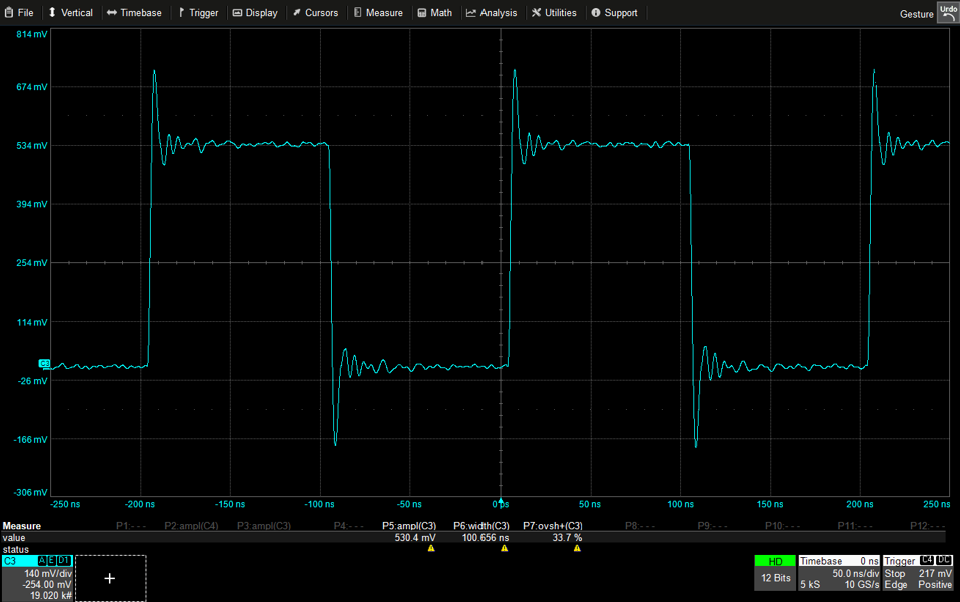
Fig 2: Digital waveform captured with a passive probe. Note the overshoot, undershoot and ringing.
Setting up a reference
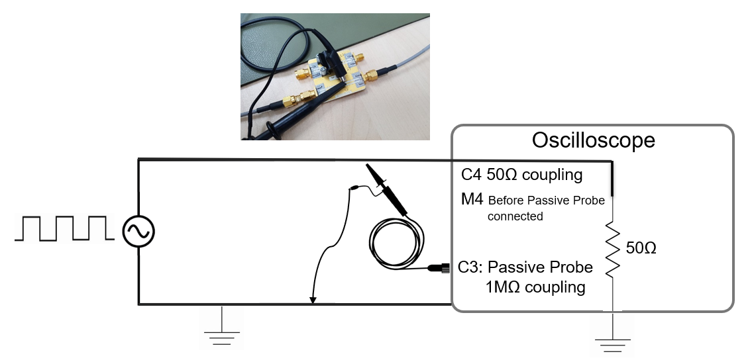
Fig 3: Signal source connected to C4 at 50 Ω. A passive probe on C3 then probes the same path.
A signal source is connected to oscilloscope channel 4 (C4) using coaxial cables with 50 Ω coupling. This waveform is saved as M4, our golden reference trace.
With M4 saved, a passive probe on channel 3 (C3) measures the same signal path. M4, C4 and C3 are then displayed together for comparison (Fig 4).
What the data reveals
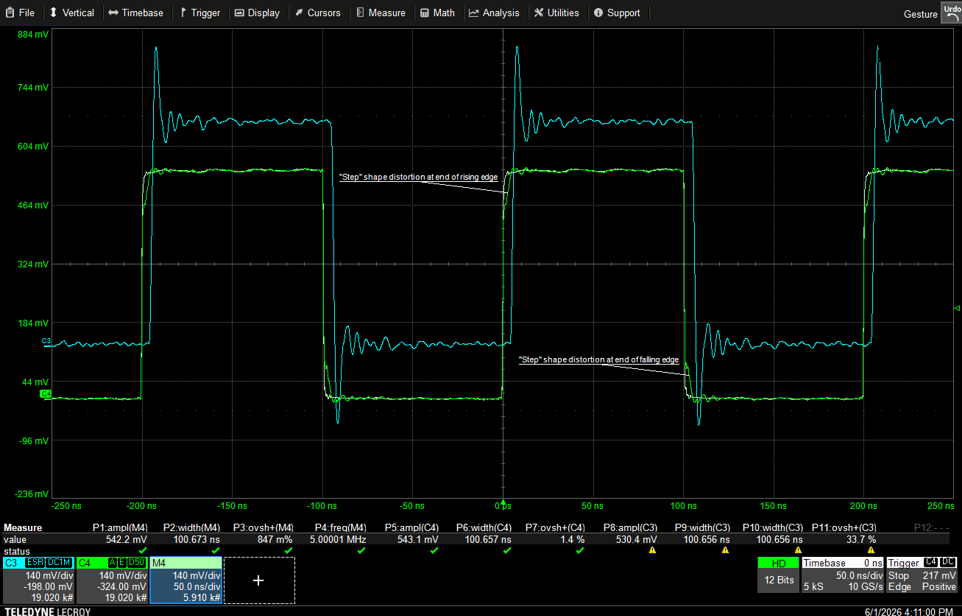
Fig 4: Reference (M4): true signal with no probe attached. Loaded circuit (C4): the same signal with the probe touching the board. Probe view (C3): the waveform seen through the passive probe.
Overshoot & undershoot up to 33%
These artifacts appear through the passive probe, but are absent in the actual circuit.
Transition times overestimated by up to 50%
Rise and fall times are inflated, skewing timing analysis.
Amplitude & frequency remain accurate
Parameters like amplitude and frequency remain reliable despite probe loading.
Step distortion at signal edges
The passive probe distorts the edges of the real circuit signal, a hallmark of capacitive loading.
| Parameter | Reference (M4) | Probe view (C3) | Result |
|---|---|---|---|
| Amplitude | 542.9 mV | 529.8 mV | Accurate |
| Frequency | 5.00001 MHz | 5.00002 MHz | Accurate |
| Period | 200.000 ns | 199.999 ns | Accurate |
| Pulse width | 100.673 ns | 100.654 ns | Accurate |
| Duty cycle | 50.337% | 50.329% | Accurate |
| Rise / fall time | 0.889 ns | 1.200 ns | Inflated |
| Overshoot | <1% | 33.7% | Artifact |
| Ringing | Absent | Prominent | Artifact |
Table 1: Reference vs passive probe measurements. Amplitude and timing parameters agree; edges, overshoot and ringing do not.
What is probe loading, and why does it happen?
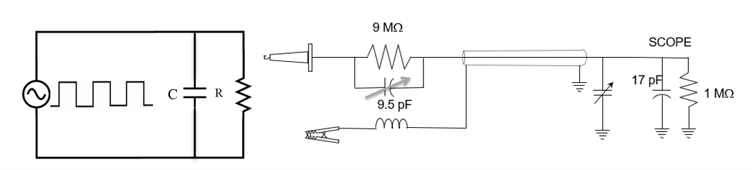
Fig 5: Equivalent RLC circuit formed when a passive probe connects to a live test point. The combined impedances create probe loading.
Passive probes carry resistance and capacitance, plus inductance in the ground lead. The oscilloscope’s high-impedance input adds its own resistive and capacitive elements. Together, they form an RLC network, known as probe loading, which causes overshoot, undershoot and ringing in captured waveforms.
High-impedance inputs are unavoidable with passive probes. Recognising this mechanism is key to interpreting oscilloscope captures correctly, and to choosing the right probing method for high-frequency or signal-integrity-critical work.
Frequently asked questions
Why is there ringing on my signal when I measure it on an oscilloscope?
Often, the ringing is not in your circuit at all. A passive probe’s ground lead adds inductance, which forms an LC circuit with the probe’s capacitance, and fast edges make it ring. To check, compare against a reference measurement taken without the probe. For the fix, see how to reduce probe loading when using passive probes.
Why does my oscilloscope show overshoot on a square wave?
This is usually the same probe loading effect. In our test, a passive probe with a sprung hook and long ground lead showed up to 33% overshoot that did not exist in the real signal. Removing the sprung hook and using a ground spring reduces it dramatically, as shown in Part 2.
What is probe loading?
Probe loading is the effect a probe’s own resistance, capacitance and inductance have on the circuit it measures. It can change the real signal in your circuit, and distort the waveform shown on the oscilloscope with overshoot, ringing and slower edges.
Speak to a Genetron T&M specialist about your measurement requirements.