Hardware-in-the-Loop (HIL) Systems

Home / Test & Measurement Solutions / Hardware-in-the-Loop (HIL) System

Hardware-in-the-Loop (HIL) systems offer a powerful and efficient way to test and validate control systems in real-time. By integrating physical hardware components or prototype with simulation and emulation models, these systems enable engineers to evaluate performance and functionality under realistic conditions without the need for complete physical prototypes.

What is Hardware-in-the-Loop (HIL)?

Hardware-in-the-Loop (HIL) is a testing methodology that combines actual hardware with simulated models to validate embedded systems. This technology allows engineers to emulate the performance of control systems in real-time, ensuring that both hardware and software components function correctly together. Additionally, HIL systems significantly shorten development timelines and reduce costs, all while improving the reliability and safety of the final products.

How Does an HIL System Work?

HIL systems operate by linking physical hardware, such as controllers or prototype devices, to a real-time simulation that mimics the behavior of the larger system. The simulation and hardware continuously exchange signals, creating a realistic closed-loop environment where the device responds as if it were operating under actual conditions.

This approach makes it possible to test a wide range of scenarios—including extreme or hazardous conditions—that would be impractical to replicate physically. By doing so, engineers can observe system responses, validate control strategies, and refine designs with greater speed, safety, and efficiency.

Engineer using tablet for digital control and system monitoring in automotive testing.
Filters

Explore Our Range of HIL System

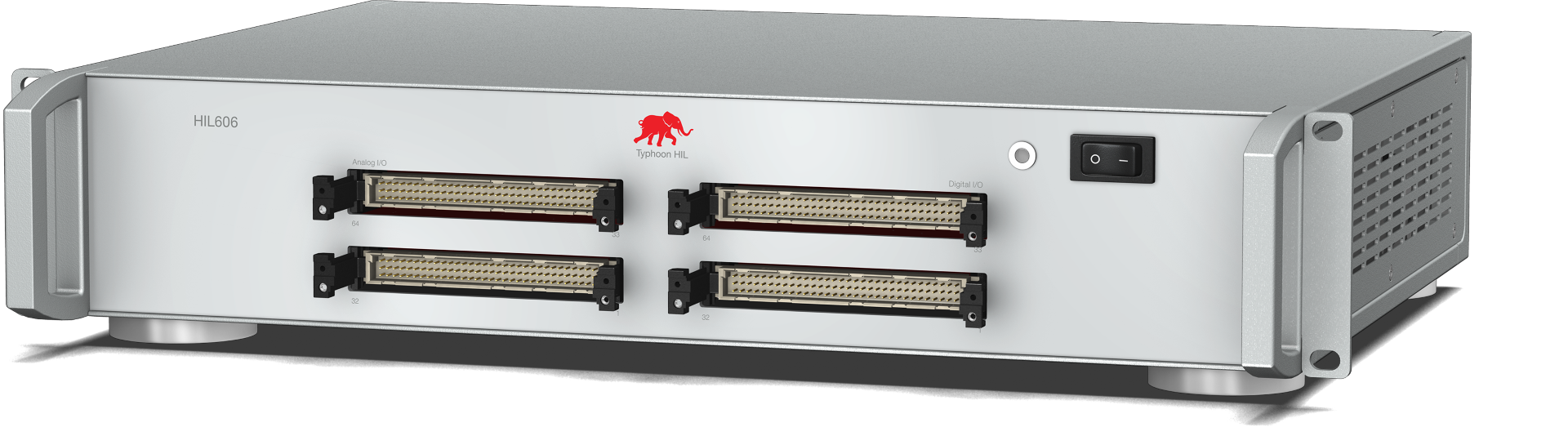
Typhoon HIL606 hardware-in-the-loop simulation system front and side view

Typhoon HIL 606

The Typhoon HIL606 is a flagship 4th-generation Hardware-in-the-Loop (HIL) simulator offering unmatched speed, power, and flexibility for real-time testing. Equipped with an 8-core processor, it enables simulation of complex models, including microgrids and fast-switching converters, with minimal simulation steps of 200 ns and digital input sampling at 3.5 ns. Its extensive connectivity options, including EtherCAT, CAN FD, and Quad SFP ports, allow seamless integration with diverse hardware and software tools. With the capacity to parallel up to 16 devices and robust support for real-time protocols, the HIL606 is ideal for advanced applications in e-mobility, microgrids, and high-frequency power systems.

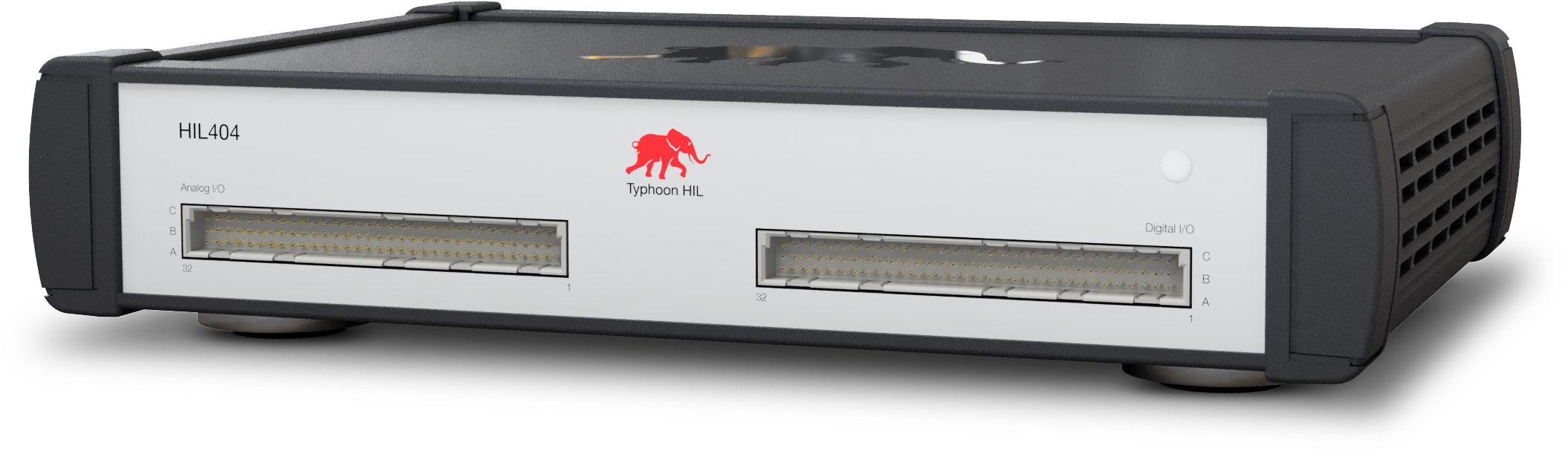
Side view of Typhoon HIL404 real-time hardware-in-the-loop testing unit

Typhoon HIL 404

The Typhoon HIL404 is a 4th-generation Hardware-in-the-Loop (HIL) testing platform offering ultra-high fidelity and exceptional speed for real-time simulations. Designed for demanding applications in power electronics and automotive systems, it supports 200 ns simulation time steps and 3.5 ns digital input sampling resolution, making it the fastest HIL device available. The HIL404 features advanced nonlinear machine modeling, real-time semiconductor power loss emulation, and seamless integration with simulation tools like MATLAB/Simulink and JMAG. With extensive connectivity options, it supports rapid control prototyping, automated testing, and real-time emulation of complex systems such as microgrids, motor drives, and battery inverters.

HIL101

Typhoon HIL 101

The Typhoon HIL 101 is a compact and powerful hardware-in-the-loop (HIL) simulator, designed for real-time testing and simulation of power electronics, microgrids, and other complex systems. It enables fast and accurate model-based testing, allowing engineers to validate control algorithms without the need for physical prototypes. The HIL 101 supports a wide range of applications and offers seamless integration with Typhoon’s software tools, making it ideal for rapid development and testing of energy systems.

Benefits of Hardware-in-the-Loop (HIL) Systems

Real-Time Testing

Our Hardware-in-the-Loop (HIL) systems enable real-time simulations, allowing engineers to assess control algorithms and system responses under dynamic conditions. This capability is crucial for the early detection of potential issues in the development cycle, enhancing the reliability of the final product while reducing overall development costs. Identifying and addressing critical failure points during the design phase is significantly more cost-effective than resolving these issues during physical testing, thereby improving efficiency and risk management in product development.

Seamless Integration

Designed to easily integrate with various hardware and software components, our HIL solutions allow for flexible testing setups. This adaptability facilitates thorough emulation of complex embedded systems, making it suitable for diverse applications across industries.

Enhanced Safety and Reliability

By emulating and validating systems in a controlled environment, our HIL technology significantly reduces the risks associated with hardware failures or design flaws. This rigorous testing process ensures that products meet safety standards and performance expectations before deployment.

Faster Development Cycles

With testing and validation occurring in tandem with system design, HIL systems help shorten the overall development process. Engineers can refine hardware and software iteratively without waiting for a complete physical prototype, accelerating innovation and time-to-market.

Cost Savings

HIL testing reduces the need for multiple physical prototypes and large-scale test environments, which leads to significant savings in both resources and operational expenses. Early detection of faults also prevents costly redesigns later in the project.

Greater Scalability and Flexibility

Whether for small subsystems or full-scale platforms, HIL systems can be scaled to match project requirements. This flexibility allows organizations to apply the same methodology from early research through to final validation.

Industries That Use HIL Systems

Hardware-in-the-Loop (HIL) systems are widely applied across industries where reliability, efficiency, and safety are critical. Key applications include:

Steps in HIL Testing

HIL systems follow a structured process that ensures hardware and software are validated thoroughly in a safe, controlled environment. The key steps typically include:

System Modelling

Engineers begin by creating mathematical models of the system to be simulated, such as a vehicle powertrain, flight control system, or microgrid. These models replicate the real-world dynamics of the system.

Integration with Hardware

The simulated environment is connected to the actual hardware under test, such as controllers, processors, or prototype devices. Input and output signals are exchanged between the simulation and hardware in real time.

Real-Time Simulation

The models run on high-performance processors capable of real-time execution. This ensures that hardware responds to simulated conditions just as it would in a live system.

Test Execution

Engineers run scenarios that may include normal operations, fault conditions, or extreme environments. This step validates control algorithms, performance, and safety functions.

Data Collection and Analysis

During testing, data is continuously captured and analyzed to identify trends, verify results, and detect potential issues. Engineers can refine algorithms or adjust hardware based on the findings.

Iteration and Refinement

The process is repeated with modified parameters, new test cases, or updated hardware. Iterative testing ensures that systems are robust and ready for real-world deployment.

Frequently Asked Questions

What is an HIL system and how does it work?

An HIL system (Hardware-in-the-Loop) is used to test and validate embedded controllers by simulating real-world conditions in a controlled environment. It works by connecting actual hardware components to a real-time simulation model, allowing engineers to observe how the system responds without needing a full physical setup. This approach improves testing accuracy while reducing development risks. As part of advanced test and measurement equipment, it is widely used in automotive, aerospace, and power electronics applications.

When should an HIL system be used instead of traditional testing methods?

An HIL system should be used when physical testing is costly, complex, or unsafe to perform in real-world conditions. It enables early-stage validation of control systems before full integration, helping identify issues earlier in the development cycle. Compared to traditional testing, it offers greater flexibility and repeatability for complex scenarios. This makes it particularly suitable for systems that require precise simulation and real-time response analysis.

What is the difference between Hardware-in-the-Loop (HIL) and Processor-in-the-Loop (PIL)?

HIL systems connect actual hardware, such as controllers or prototype devices, to a real-time simulation to validate how hardware and software work together. PIL, on the other hand, focuses on verifying the software code running on a processor by connecting it to a simulation model, without involving the physical hardware components.

Why choose HIL testing over traditional testing methods?

HIL testing offers a more realistic and cost-effective approach compared to traditional approaches, which often rely solely on simulations or physical prototypes. By combining hardware with real-time simulation, HIL systems allow engineers to uncover issues earlier, test under a wider range of conditions, and reduce the need for repeated physical builds. This leads to faster development cycles and safer, more reliable systems.

What types of systems can we validate using HIL testing?

HIL systems can be used for any system that relies on embedded controllers or complex algorithms, ensuring that hardware and software work together correctly before deployment.

Can HIL systems be customized for specific applications?

Yes, HIL systems are highly adaptable and can be tailored with different models, interfaces, and configurations. This flexibility makes them suitable for everything from renewable energy systems to robotics and advanced control applications.

Do HIL systems require specialized training to operate?

While HIL simulations are powerful tools, they can be complex to set up and use effectively. At Genetron, we offer comprehensive technical support to help your team gain the expertise needed to maximise your investment.

How does HIL testing improve product safety?

HIL systems allow engineers to test hardware responses under extreme or fault conditions without putting people or equipment at risk. This makes it possible to validate safety features and test edge cases thoroughly before the system is ever deployed in the real world.

How does HIL testing improve system development?

y enabling real-time simulation and emulation testing in a controlled environment, HIL reduces development time and costs. Engineers can identify and resolve issues early in the design process, resulting in more reliable systems.

What types of systems can benefit from HIL testing?

HIL testing is particularly useful for automotive, such as Electric Car or Mobility, aerospace, renewable energy, industrial automation systems, microgrid such as one found in a Maritime Ship or Vessel, power systems as well as a Digital Power Substation or Control Centre. Any application requiring complex control algorithms can gain from this testing methodology.

How does HIL compare to traditional testing methods?

Unlike traditional testing, which may rely solely on software simulations or post-development tests, HIL combines both hardware and software for comprehensive emulation tests. This approach ensures that systems are rigorously tested before deployment.

Is HIL testing suitable for all stages of development?

Yes, HIL testing can be beneficial at various stages, including initial design, integration, and final validation. It helps ensure that all components work harmoniously throughout the development. At the end of the project, the models developed and tested can become a Digital Twin for the deployed solution.