Article by John Ong | 11 June 2025
Fast Acquire & Display Oscilloscopes
Recently, I encountered an electronics waveform that resembled composite video signals—something I haven’t seen since the days of analog TV. I started off using an entry-level oscilloscope boasting a capture/update rate in excess of 100,000 waveforms per second. I stared at the waveform displayed on the oscilloscope (Figure 1), asking myself… “What is going on here? What signal is really moving around in my circuit?”

Figure 1: Fast update rate capture. Signal is clearly present & at the expected voltage.
Captured using a simple edge trigger, I could tell from the acquisition that the signal was present, and the amplitude was as expected (2.5 V). However, many questions remained unanswered—this drove me to power up another oscilloscope featuring more advanced functions.
Capture & Zoom Oscilloscopes
The Teledyne LeCroy HDO6000B is a mid-range digital oscilloscope. While it doesn’t acquire and display waveforms at hundreds of thousands per second, it offers superior waveform display capability. In Figure 2, the HDO6000B acquired 5 ms of the same signal captured in Figure 1 (which only covered 50 µs)—100 times longer.
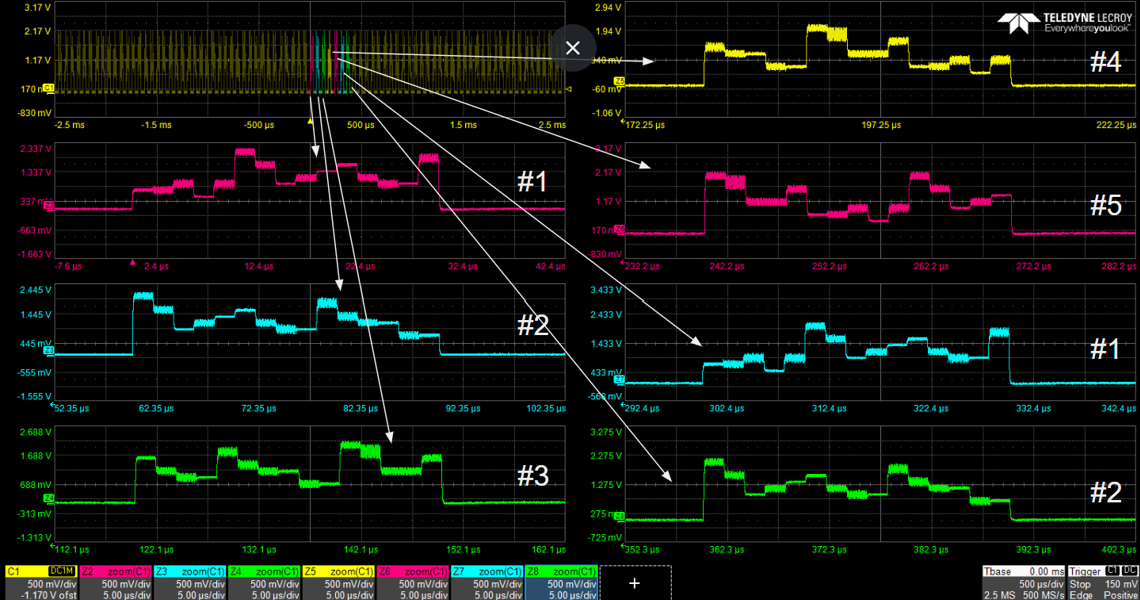
Figure 2: Using zoom functions to view different adjacent waveform bursts to gain understanding.
A longer acquisition, coupled with zoom functionality, allowed me to examine adjacent waveform segments. This revealed five distinct burst types (#1, #2, #3, #4, and #5), occurring in a specific and repeated order. The seven burst zooms confirm the repeatable pattern (#1 – #2 – #3 – #4 – #5).
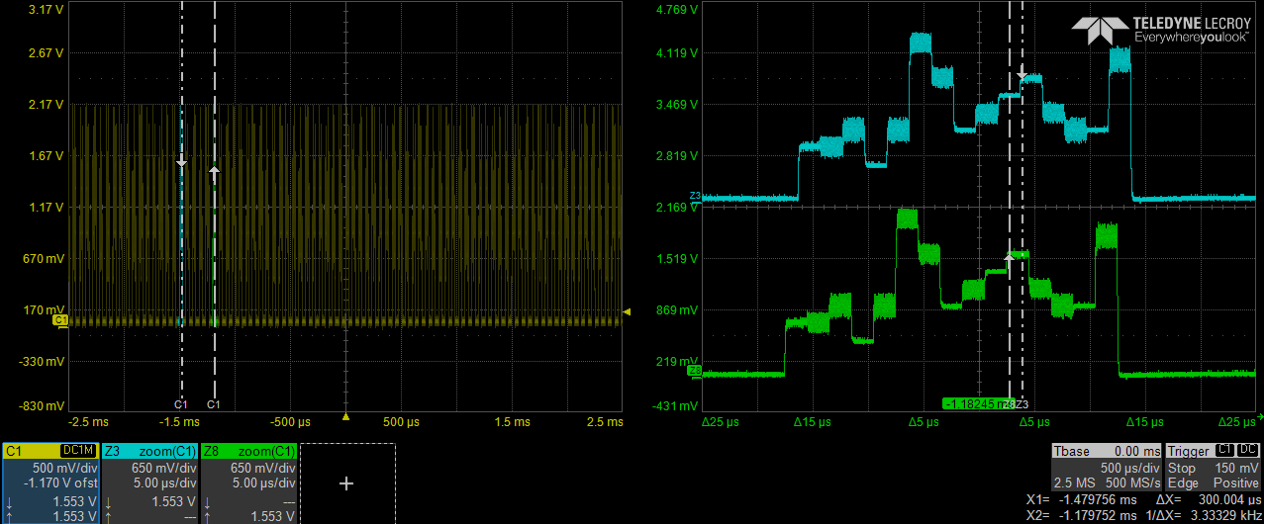
Figure 3: Cursor measurement of time between #1 bursts (Δx = 300 µs).
By placing cursors on subsequent burst #1s, I could determine that the full pattern lasts 300 µs, with each individual burst occupying approximately 60 µs.
Conclusion
Some waveforms may appear complex and perplexing when viewed on a fast-acquire, fast-display oscilloscope. However, by switching to a capture & zoom oscilloscope, waveform behaviour and repeatability are revealed more clearly. This allows users to quickly understand the waveform’s true nature and characteristics.