How to Choose the Right Power Supply
Choosing the right power supply is essential for achieving stable performance, energy efficiency, and accurate test results. Whether selecting a programmable power supply for automated testing or a DC power supply for industrial use, considering the following factors will ensure you get the best fit for your needs.
1. Identify Your Power Requirements
Determine the required voltage, current, and power capacity. A DC power supply is ideal for applications needing stable direct current, such as circuit testing and device development. If your application requires dynamic voltage changes, a programmable power supply allows precise adjustments for greater flexibility.
2. Consider Power Supply Type
- Fixed DC Power Supply – Provides a constant output and is ideal for applications that require stable and unchanging voltage and current.
- Programmable Power Supply – Allows users to customise voltage and current settings for different testing scenarios, making it useful in R&D and production environments.
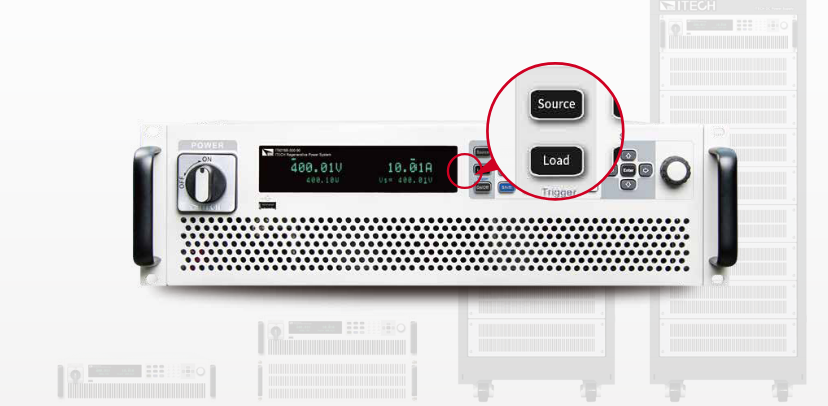
- Regenerative Power Supply – Best for applications that require energy recovery, such as battery testing and electric vehicle simulations.
3. Evaluate Efficiency and Features
Energy efficiency is a key factor when selecting a power supply. A regenerative power supply reduces energy waste by recycling excess power back into the grid. Additionally, features like remote programmability, overvoltage protection, and current-limiting functions improve safety and ease of operation.
4. Application-Specific Considerations
- For Electronics Testing: A high-precision DC power supply with low noise is essential for circuit analysis and component testing.
- For High-Power Applications: A programmable power supply with fast response time and high stability ensures reliable testing of industrial equipment.
- For Energy Recovery: A regenerative power supply is ideal for applications requiring bidirectional power flow, such as battery cycle testing and renewable energy simulations.
5. Size and Scalability
Compact power supplies are best suited for laboratory and R&D environments where space is limited. For large-scale industrial applications, modular and scalable systems allow for power expansion to meet growing demands.
By assessing these factors, businesses can select the ideal high-efficiency programmable power supply or DC power supply in Singapore that aligns with their specific requirements, ensuring performance, reliability, and cost-effectiveness.
Types of Power Supplies
Power supplies come in various types, each designed to meet specific application requirements. Whether for industrial testing, research laboratories, or high-precision electronics, selecting the right power supply is essential for efficiency and reliability.
AC Power Supply
An AC power supply converts mains power into controlled voltage and frequency outputs, making it ideal for industrial equipment, appliances, and motor testing.
DC Power Supply
A DC power supply converts alternating current (AC) from the mains into direct current (DC) with regulated voltage and current outputs. Used extensively in electronics testing, automotive applications, and telecommunications, it ensures stable power delivery for sensitive components.
Programmable Power Supply
A programmable power supply offers dynamic control over voltage, current, and power settings, enabling automated testing and precision in industries like aerospace and semiconductor manufacturing.
Regenerative Power Supply
A regenerative power supply not only delivers power but also feeds excess energy back to the grid, reducing waste and operational costs. Ideal for battery testing and sustainable energy applications. This energy-efficient solution is particularly useful in applications requiring bidirectional power flow, such as battery testing and renewable energy simulations.
Choosing the right power supply, whether a DC power supply or an advanced programmable power supply, ensures optimal performance, efficiency, and reliability across industries in Singapore.
Differences Between Linear and Switched Programmable Power Supplies
Programmable power supplies come in two main types—linear and switched—each suited to different applications based on performance requirements and design considerations.
Linear Power Supplies
Linear power supplies offer a simple design that produces a clean and stable output. These are ideal for applications requiring low noise and minimal electromagnetic interference (EMI). Their drawback is lower efficiency and a bulkier form factor due to larger components.
Switched Power Supplies
Switched power supplies, in contrast, use advanced switching techniques to convert power efficiently, resulting in a compact and lightweight design. While they provide higher efficiency and flexibility, their output may have higher noise levels, making them less suited for noise-sensitive tasks.
Understanding these differences allows engineers to select the appropriate power supply for specific requirements, ensuring both performance and cost-effectiveness.