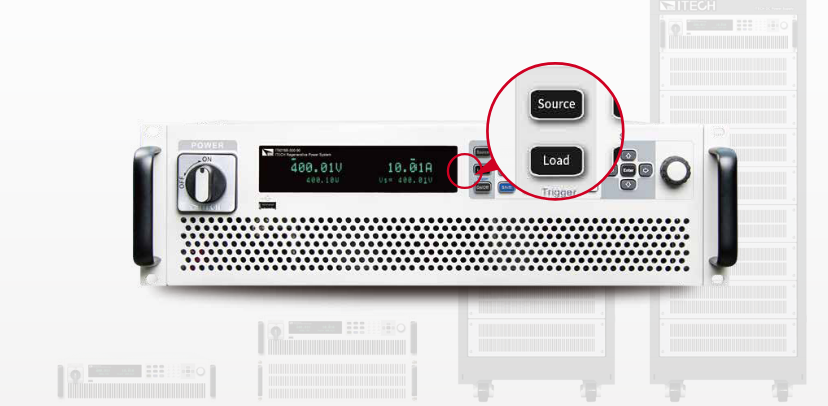
Power Supply Testing
Electronic loads are used to evaluate the performance of AC/DC and DC/DC power supplies by simulating varying load conditions. This helps verify voltage stability, transient response, and overload protection.
Battery and Energy Storage Evaluation
Engineers use electronic loads to test battery discharge characteristics, capacity, and efficiency. Genetron’s systems allow precise control to assess energy storage behaviour under constant current, constant resistance, or pulsed conditions.
Solar and Renewable Energy Systems
In solar and renewable applications, electronic loads help simulate dynamic energy consumption patterns to test inverters and energy management systems, ensuring optimal energy conversion and reliability.
Automotive and Aerospace Electronics
Electronic loads play a critical role in testing automotive ECUs, alternators, and other onboard systems under various electrical loads. Their precision helps ensure component safety and compliance with rigorous industry standards.
How to Choose the Right Electronic Load
Form Factor and Scalability
Opt for a compact, modular electronic load that provides flexibility for both current and future needs. Modular systems allow easy expansion or reconfiguration, making them ideal for automated test equipment (ATE) setups that may evolve over time.
Capacity and Power Ratings
Confirm that the electronic load can safely handle the voltage, current, and power levels of your device under test (DUT). Always ensure sufficient operating range and safety margins to prevent overload and maintain long-term system reliability.
Speed and Response Time
For applications requiring dynamic performance, choose a load with fast slew rates and programmable ON/OFF timing. A high-speed electronic load can emulate rapid waveform transitions, generate complex signals, and measure results accurately within the desired bandwidth, helping improve overall test throughput.
Operating Modes
Different tests require different control modes.
– Constant Current (CC): For power consumption testing.
– Constant Resistance (CR): To replace resistors or simulate passive loads.
– Constant Voltage (CV): For testing current sources.
– Constant Power (CP): To assess energy storage capacity and efficiency.
A versatile load that supports multiple modes offers greater flexibility across varied applications.
Dynamic Load Testing
If your testing involves transient or real-world load changes, select a load with built-in waveform generation or arbitrary function capability. Ensure it can reproduce patterns like sine, pulse, step, or ramp waveforms with sufficient sampling rate and memory to simulate realistic operating profiles.
Flexibility and System Integration
A modular, system-ready electronic load allows seamless integration with power modules, controllers, and other instruments in your setup. Synchronisation within a single test environment simplifies operation and enables a complete, turnkey testing solution.
Safety and Protection Features
Prioritise safety by choosing an electronic load equipped with built-in overvoltage, overcurrent, overpower, and overtemperature protection. Automatic shutdown mechanisms help safeguard both the instrument and the DUT from potential damage during testing.